For many years, buckwheat was considered a predominantly “domestic” crop — nutritious, filling, and healthy, yet not oriented toward export markets. Over the past three years, however, the situation has changed dramatically. Grain exports to China have increased dozens of times, global demand for gluten-free products continues to grow, and Russia has firmly established itself as the only major supplier to the Asian market.
The Global Buckwheat Market: Size, Growth Dynamics, and Demand Trends
The global buckwheat market was valued at approximately $620 million in 2024. Analysts forecast annual growth of around 3% through 2034.
Buckwheat is cultivated in only two to three dozen countries worldwide. Russia and China together account for nearly 60% of global production. Despite China’s own harvest volumes, the country still covers part of its domestic demand through imports — creating the primary growth opportunity for international suppliers.
Several factors are driving global demand:
- the increasing popularity of gluten-free products in Europe and Asia;
- the shift of grain markets toward niche crops with higher added value;
- the global trend toward healthy eating.
Buckwheat fits perfectly into these trends, as it is gluten-free, rich in protein and rutin, and has long been part of the traditional diet in major Asian countries.
Main Types of Buckwheat
Competitive Advantages of Russian Buckwheat: Variety, Quality, and Attractive Pricing
According to BusinesStat data published in January 2026, Russian buckwheat exports increased almost fourfold between 2021 and 2025 — from 72 thousand tons to 283 thousand tons. Russia remains the sole major supplier of buckwheat to the Chinese market, effectively covering all of China’s imported demand.
Traditionally, cultivated areas exceeded 1 million hectares, although they declined to 746 thousand hectares last year as farmers responded to domestic oversupply and falling prices.
The quality of Russian buckwheat is supported by several stable competitive advantages:
- Large harvest volumes combined with relatively low agrochemical intensity, especially in Siberia and the Urals;
- A wide variety of cultivars, including common buckwheat (the primary export product) and Tartary buckwheat, highly valued in China and Japan;
- Advanced domestic processing capabilities, allowing exports of both raw grain and finished groats;
- Record yields in 2025: 13.4 centners per hectare — the highest result in the history of buckwheat cultivation in Russia.
Russia also offers a broad selection of buckwheat varieties. According to the 2025 Rosselkhoznadzor ranking, the most popular varieties include “Devyatka” (8.0 thousand tons of sowing volume), “Dasha” (7.5 thousand tons), “Svetlana” (3.3 thousand tons), “Dizayn” (3.0 thousand tons), and “Inzerskaya” (1.5 thousand tons).
Buckwheat prices in Russia depend on several factors, including harvest yields, weather conditions, domestic consumption, export demand, the ruble exchange rate, and logistics. After the sharp price surge of 2020–2022, the market gradually stabilized.
Average Buckwheat Prices in Russia (2015–2025)
| Year | Average Retail Price |
| 2025 | 85 RUB/kg |
| 2024 | 82 RUB/kg |
| 2023 | 74 RUB/kg |
| 2022 | 90 RUB/kg |
| 2021 | 78 RUB/kg |
| 2020 | 80 RUB/kg |
| 2019 | 52 RUB/kg |
| 2018 | 48 RUB/kg |
| 2017 | 42 RUB/kg |
| 2016 | 38 RUB/kg |
| 2015 | 45 RUB/kg |
Average retail prices based on open-source data and market analytics.
Consumption Culture and Health Benefits of Buckwheat
In Russia, buckwheat traditionally ranks second only to potatoes on the family dining table. Russian consumers primarily eat brown buckwheat in the form of porridge and side dishes. This tradition dates back to the Soviet era, when steaming and roasting technologies became widespread. Such processing extended shelf life and reduced cooking time.
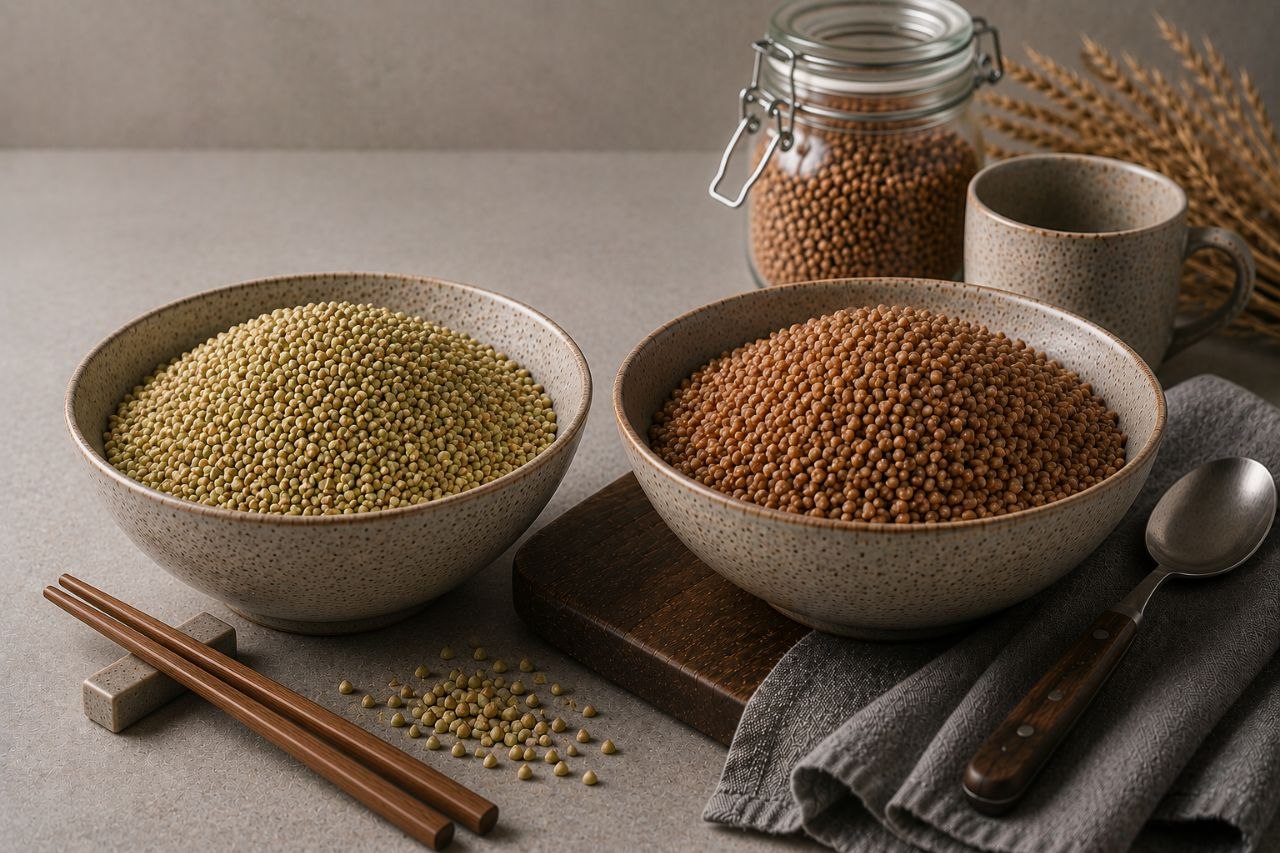
In China, Japan, South Korea, and Southeast Asian countries, green buckwheat is preferred due to the growing popularity of healthy eating. Green buckwheat contains significantly higher levels of rutin, a compound beneficial for strengthening blood vessels and capillary systems.
For many Russian consumers, however, green buckwheat still appears “raw” and unusual.
In addition to green and brown buckwheat, there is also white buckwheat:
- Green buckwheat undergoes no thermal processing;
- White buckwheat is steamed before drying;
- Brown buckwheat is additionally roasted, giving it a darker color and richer flavor, although roasting reduces rutin content.
The main commercial forms of buckwheat are:
- Whole groats (yadritsa) — intact kernels cleaned from hard husks;
- Split groats (prodel) — broken grains.
Other processed products include:
- Buckwheat flakes — produced by flattening grains and valued for their low calorie content;
- Steamed buckwheat groats — hydrothermally processed grain with extended shelf life;
- Unsteamed groats — minimally processed grain;
- Green buckwheat — naturally dried grain retaining its natural green-yellow color;
- Buckwheat flour — widely used in noodle production, gluten-free baking, and Asian cuisine. The best-known example is Japanese soba noodles.
Processing and Industrial Applications: From Groats and Flour to Pharmaceuticals and Cosmetics
Most international buyers perceive buckwheat primarily as a food grain, but in reality it serves as raw material for multiple industries.
Food processing applications include:
- Whole grains and split groats for porridges and baby food;
- Flour for bakery products, pancakes, and noodles;
- Flakes and granules for muesli, snacks, and healthy food products.
However, buckwheat also extends beyond food retail shelves:
- Rutin extracted from buckwheat is widely used in pharmaceuticals for vascular health;
- Buckwheat husks are used as filling material for orthopedic pillows and mattresses, especially popular in Asian countries;
- Buckwheat flour is used in cosmetics as an ingredient in facial masks and scrubs.
Overall, buckwheat processing can be developed across several sectors — food, pharmaceutical, textile, and cosmetic industries.
Leading Production Regions
Buckwheat production in Russia is concentrated mainly in two federal districts — Siberian and Volga.
Altai Krai is the undisputed leader. In 2024, the region harvested more than 661 thousand tons, accounting for over 55% of the country’s total output. Even with reduced sowing areas last season, the region still produced 585 thousand tons. Climate conditions, soil quality, and accumulated agricultural expertise have made Altai the country’s primary “buckwheat province.”
Other major producing regions include:
- Republic of Bashkortostan;
- Novosibirsk Region;
- Kurgan Region;
- Oryol Region.
Chelyabinsk Region has also significantly increased production in recent years.
The geographic concentration of production in Siberia provides an important logistical advantage for exports to Asia. Grain is transported by rail to the Chinese border, making deliveries predictable and relatively cost-efficient.
China: The Largest Importer and Processor
China remains the main export market for Russian buckwheat. By the end of 2025, China accounted for more than 95% of all Russian buckwheat exports.
According to China’s General Administration of Customs, buckwheat exports to China reached 183 thousand tons worth $49 million in the first half of 2025 alone — 55% higher by volume than during the same period the previous year.
Russia’s nearest competitors — Canada and Bolivia — remain far behind.
In China, buckwheat is perceived primarily as a healthy food product and is used for:
- Soba noodle production;
- Buckwheat tea popular in Sichuan Province;
- Bread and diabetic food products;
- Cereals and porridges associated with “clean eating” trends.
Chinese customs statistics combine raw grain and processed groats under a single category, indicating that China imports both raw materials and finished products.
Exports continue year-round, with seasonal peaks typically occurring during autumn and winter.
In June 2025, Agroexport and the Russian Ministry of Agriculture organized a business mission in Chengdu, where Russian companies met directly with Chinese processors and distributors.
Opportunities for International Buyers
For international partners, Russian buckwheat has become one of the most in-demand agricultural products from Russia.
The country exports both:
- raw grain (HS 100810);
- processed groats and value-added products.
Average export prices in recent years stood at approximately $332 per ton.
Logistics infrastructure is already well developed:
- Rail transportation to China;
- Maritime shipping through Far Eastern ports;
- Standardized customs clearance and documentation procedures.
If you are looking for grain exporters in Russia, the G2R platform provides direct access to verified suppliers. Buyers can submit inquiries through relevant product listings, after which a manager contacts them to clarify specifications and supply conditions.
The platform also assists with:
- counterparty verification in Russia;
- payment processing;
- logistics organization;
- customs clearance.
As a result, international buyers only need to receive the goods in their destination country.
Investment Potential and Outlook Through 2030
Foreign investors considering Russian agriculture should understand several legal limitations:
Agricultural Land Ownership
Foreign individuals, companies, and organizations with more than 50% foreign ownership cannot directly own agricultural land in Russia. Leasing arrangements are permitted instead.
Strategic Assets
Investments in strategically important companies or sectors may require approval from the Government Commission on Foreign Investments.
Dual Citizenship
Individuals holding Russian citizenship alongside another nationality are not restricted in agricultural land ownership rights.
Given these limitations, the most promising investment formats include:
- Joint ventures with Russian partners;
- Investments in processing rather than land acquisition;
- Export-oriented agricultural projects;
- Participation in government-supported agricultural programs.
In 2025, more than 530 billion rubles were allocated to support the agricultural sector, including subsidized interest rates and compensation of up to 30% of capital modernization expenses.
Experts estimate that buckwheat export potential will grow by more than 4% annually starting from 2026, primarily driven by rising demand in Southeast Asia.
Potential Investment Niches
- Construction of processing facilities (groats, flour, flakes, industrial husk products);
- Investments in breeding and seed production;
- Export logistics infrastructure for Asian markets;
- Organic and environmentally friendly buckwheat production.
Key Expectations Through 2030
- Export growth of at least 4% annually beginning in 2026;
- Potential to reach $100 million in exports to China by 2030;
- Stable domestic consumption at approximately 550 thousand tons annually;
- Expansion of deep-processing projects, especially in Siberia and the Urals.
Thus, for international investors, the Russian buckwheat sector represents a promising asset with stable consumer demand, a secured export market, and growing cash flow potential. It is one of the few agricultural segments where Russia holds a near-monopoly position in the global market — supported by genuine product quality and substantial production capacity.