Moscow knows how to surprise. Here, ancient cathedrals stand alongside skyscrapers, 18th-century parks transition into modern art clusters, and beneath your feet lies a metro that is itself a museum. Coming here for two days and leaving with the feeling that a week wasn’t enough — that’s an absolutely normal story.
This guide is for those who want to see the main attractions of Moscow in a few days without drowning in endless lists. The G2R.Asia platform has prepared a collection of landmark attractions, interesting places away from tourist trails, and practical tips that you absolutely need to know before your trip.
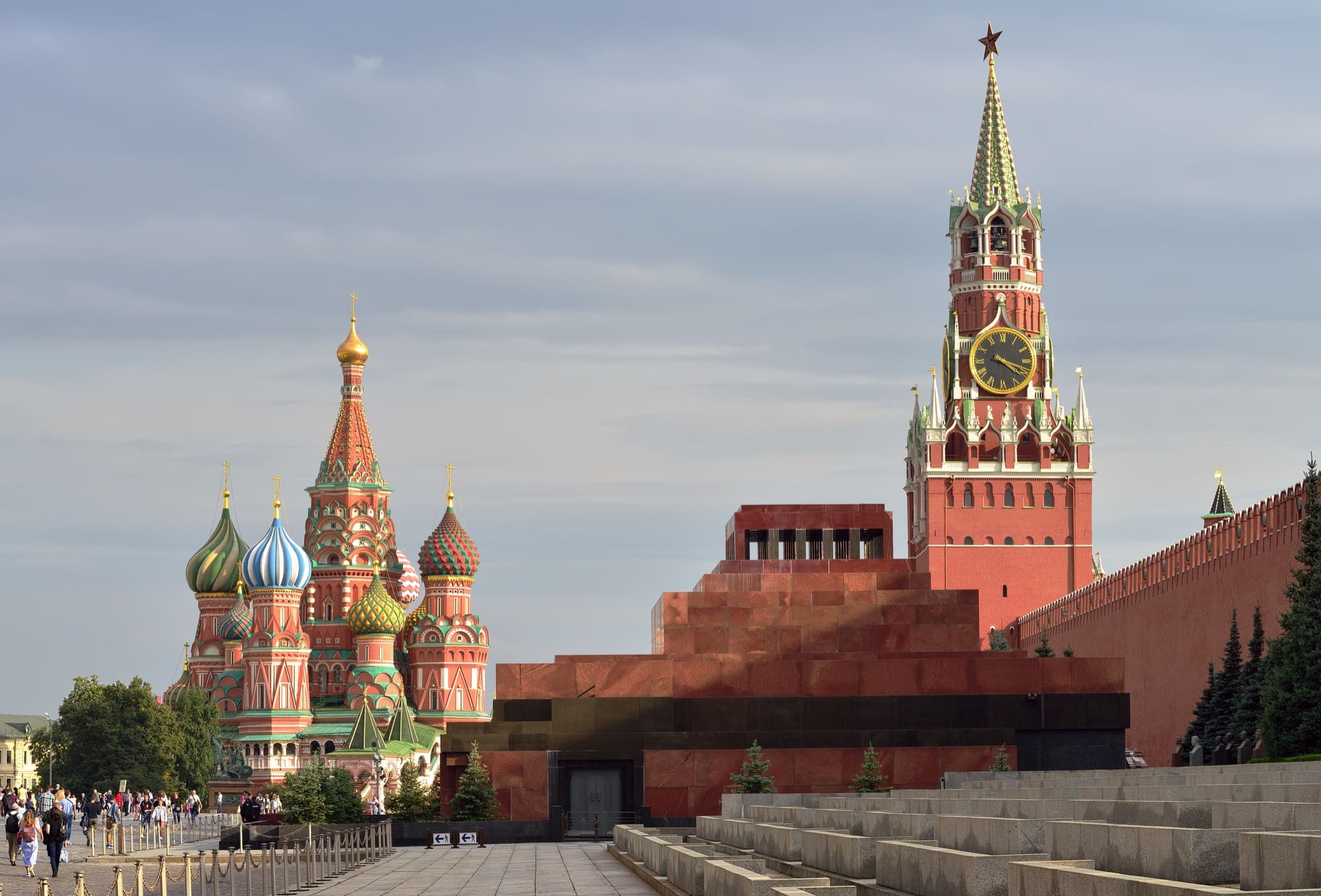
Red Square and the Moscow Kremlin — Where Moscow Begins
Whatever route you choose, it will inevitably lead here. Red Square is the heart of Moscow, a place where all roads, eras, and postcard views converge. In person, it impresses with its scale: paved with cobblestones, framed by the Kremlin walls on one side and the facade of GUM on the other.
The Moscow Kremlin is a fortress, residence, museum, and UNESCO World Heritage Site all in one. You can spend half a day on its grounds: the Assumption Cathedral, the Archangel Cathedral, and the Annunciation Cathedral, the Ivan the Great Bell Tower, the Armoury Chamber with tsarist regalia, and the Diamond Fund. The Palace of the Facets, built by Italian architects in the 15th century, is one of the oldest civil buildings in Moscow. Tickets to the Armoury Chamber and the Diamond Fund sell out quickly — book online several days in advance.
St. Basil’s Cathedral — the cathedral with its famous colorful domes has become a symbol of Moscow for the entire world. Inside is a labyrinth of nine separate churches, each with its own unique frescoes. Next to the cathedral is the State Historical Museum, whose collection covers the entire history of Russia. The museum’s exhibition begins with the Stone Age and ends at the beginning of the 20th century — more than five million items.
Lenin’s Mausoleum is worth visiting if only out of curiosity: admission is free, but opening hours are limited, and the queue can be long. GUM — the famous department store opposite the Kremlin — attracts visitors not only with its shops but also with its architecture: glass vaults, a fountain, the atmosphere of old Moscow.
Red Square is especially beautiful in the evening when the lights come on. This is one of the most visited places in Moscow, and it’s worth it — here you truly feel the scale of the country.
Walking Through Historic Streets: Nikolskaya, Arbat, Kitay-gorod
The center of Moscow is compact enough to cover several landmark streets in a single walk. Each one has its own character.
Nikolskaya — a pedestrian street in Moscow leading from Red Square to Lubyanka. In the evening, it transforms into a corridor of light from garlands and illuminated facades. Here you’ll also find the Printing Yard — the place where Ivan Fyodorov printed the first Russian book in the 16th century. Cafes, restaurants, and historic buildings make Nikolskaya one of the most pleasant streets for a stroll.
Old Arbat — a pedestrian zone just over a kilometer long, filled with street artists, musicians, and souvenir shops. The atmosphere is bohemian: Pushkin, Bulat Okudzhava, and Andrei Bely lived here. If you need souvenirs — matryoshka dolls, scarves, folk crafts — Arbat will solve this problem in half an hour.
Kitay-gorod — a district with a misleading name. It has nothing to do with China: «kita» in Old Russian means a woven fence. This is one of the oldest trading quarters of the capital, where merchant chambers stand alongside quiet churches in the lanes.
Varvarka Street — the oldest street in Moscow, descending from Red Square to the embankment. The Romanov Boyar Chambers, the Znamensky Cathedral, the old English Court — all of this is an open-air museum in the very center of the city.
Main Museums: The Tretyakov Gallery, The Pushkin Museum, The Bolshoi Theatre
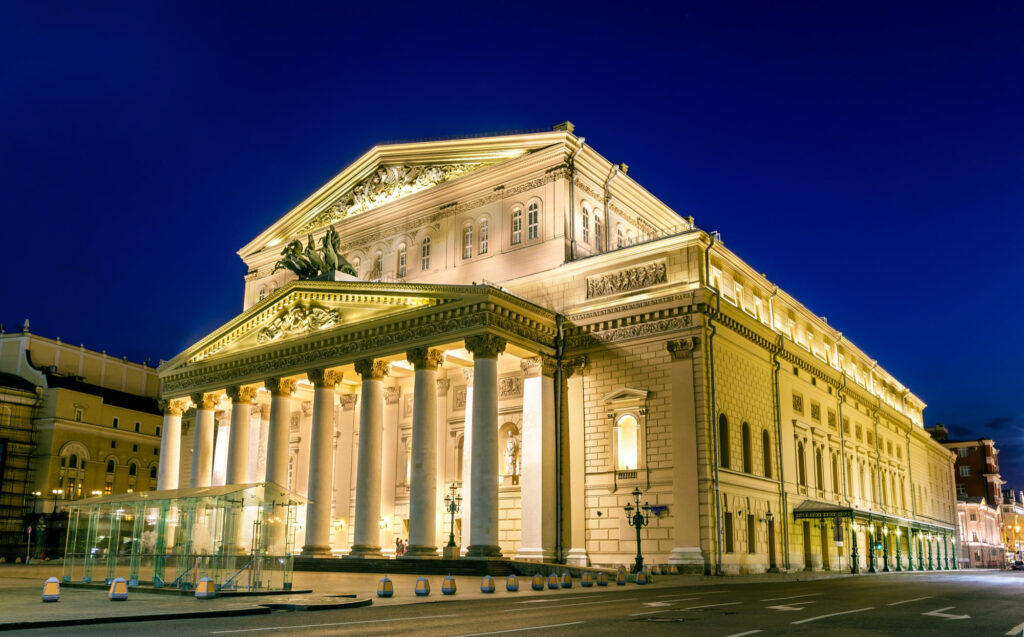
Three places that people travel to Moscow specifically for.
The Tretyakov Gallery — the largest collection of Russian painting in the world. Icons by Rublev, canvases by Repin, Surikov, Serov, Vrubel, avant-garde works by Malevich and Kandinsky. The main building in Lavrushinsky Lane is dedicated to art before the 20th century, while the branch on Krymsky Val houses the 20th-century collection. For a first visit, two to three hours in the main building will suffice. This is one of the main attractions of Moscow and all of Russia.
The Pushkin State Museum of Fine Arts — a world-class exhibition: from Egyptian sarcophagi and ancient plaster casts to a collection of Impressionists — Monet, Renoir, Van Gogh, Cézanne. If you’re already familiar with Russian art, the Pushkin Museum will broaden your horizons.
The Bolshoi Theatre — one of the most famous opera and ballet theatres in the world. The building itself on Theatre Square is an architectural monument, and the interior decor astounds with gold and velvet. Getting tickets to a performance is a challenge: they sell out weeks in advance. But even if you can’t manage it — the square in front of the Bolshoi Theatre and a backstage tour are also worth your attention.
Parks and Estates: Nature in the Big City
Moscow is a city of parks. There are hundreds of them here, and among them are true masterpieces of landscape art.
Zaryadye Park appeared in 2017 near the Kremlin walls and instantly became one of the most visited attractions in the capital. Four natural zones — tundra, steppe, forest, and floodplain meadows — are recreated on a small territory in the city center. The «floating» bridge over the Moscow River embankment offers a panoramic view that is worth seeing.
Gorky Park — the main place for recreation in Moscow since 1928. Walkways along the Moscow River embankment, a skate park, a boat station, and in winter — an open-air ice rink. Gorky Park has long ceased being «Soviet» and has transformed into a modern European space with cafes, lecture halls, and festivals.
Tsaritsyno Estate — an 18th-century palace ensemble built by order of Catherine II. Architect Bazhenov created a unique complex in the Russian Gothic style. The park is enormous: ponds, bridges, a fountain, well-maintained walkways — an ideal place for a half-day stroll.
Kolomenskoye Museum-Reserve — a residence of Russian tsars on the high bank of the Moscow River. The Church of the Ascension from 1532 is a UNESCO World Heritage Site. Here you’ll also find apple orchards, the wooden palace of Alexei Mikhailovich, and historic buildings.
Kuskovo Estate Museum — the estate of the Counts Sheremetev in the Enlightenment era style. Palace architecture, a French-style formal garden, a greenhouse, and the largest ceramics collection in Russia. Located in the east of Moscow and little known to mass tourists — which is a shame.
Architectural Contrast: From Stalinist Skyscrapers to Moscow City
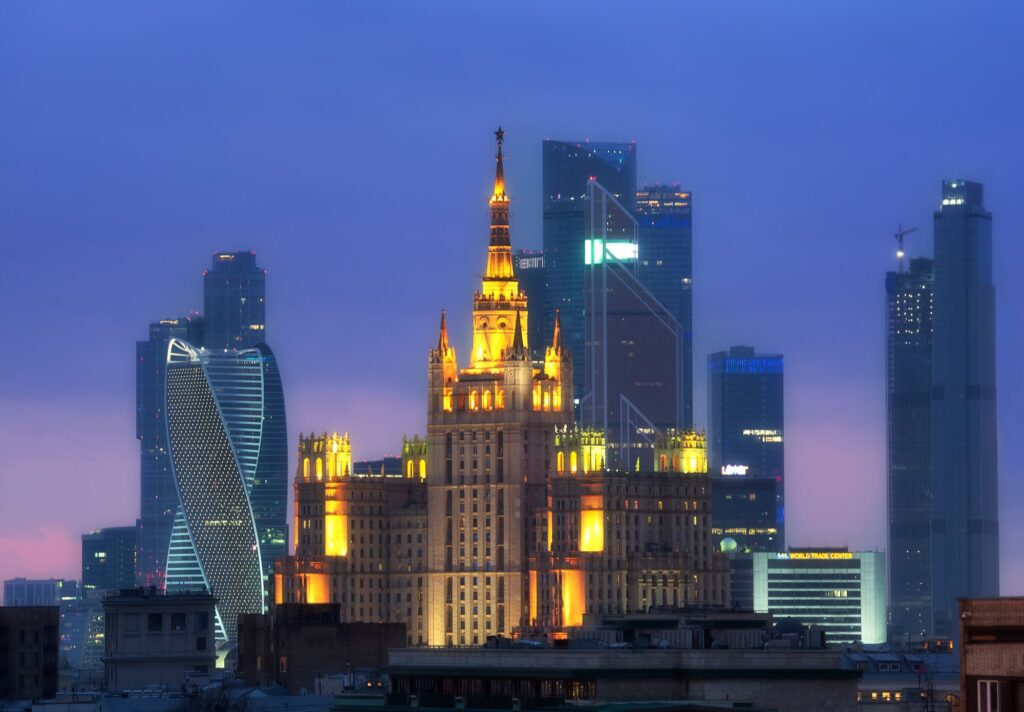
Moscow’s skyline cannot be confused with any other city in the world. Here, monumentality competes with futurism — and both sides win.
The Seven Stalinist Skyscrapers — landmark buildings erected in the late 1940s to early 1950s. The main building of Moscow State University, the Hotel Ukraina, the tower on Kotelnicheskaya Embankment — each tower has its own character. Nowhere else in the world is there an equivalent: seven monumental buildings built according to a unified plan almost simultaneously. This is a unique architectural monument that defined the city’s appearance.
The Cathedral of Christ the Saviour — the largest cathedral of the Russian Orthodox Church, standing on the Moscow River embankment. Destroyed in 1931, restored in the 1990s. The Cathedral of Christ the Saviour impresses with its scale: monumental murals, marble reliefs, an observation deck. It’s worth going inside, even if you’re far from religion.
Moscow City — a business center and cluster of skyscrapers on Presnenskaya Embankment. Federation Tower — 374 meters, one of the tallest in Europe. Here you’ll also find restaurants on the upper floors, from where the city lies open like the palm of your hand. The contrast of glass towers and the golden domes of the old city — that’s the very picture that defines modern Moscow.
Moscow from Above: Sparrow Hills, Ostankino Tower, and the Best Views
Seeing Moscow from a bird’s eye view is a mandatory item on the program. The city sprawls across an enormous territory, and only from above do you realize its true scale.
Sparrow Hills — the most famous observation deck in Moscow. Free, outdoors, with a view of Luzhniki Stadium, Moscow City, and the entire city center. Nearby is the Moscow State University building, a cable car across the river, and eco-trails in the forest park. Sparrow Hills is beautiful in any season — the winter panorama from here is no less impressive.
Ostankino TV Tower — an observation deck at a height of 337 meters. On a clear day, you can see 70 kilometers around. The «Seventh Heaven» restaurant slowly rotates around its axis, so over dinner you’ll see the city from all sides. Tickets are available online.
Another option is the 89th floor of Federation Tower in the Moscow City business center. In the evening, the city looks particularly spectacular from here.
VDNKh and the Museum of Cosmonautics — Soviet Scale and Space Technology
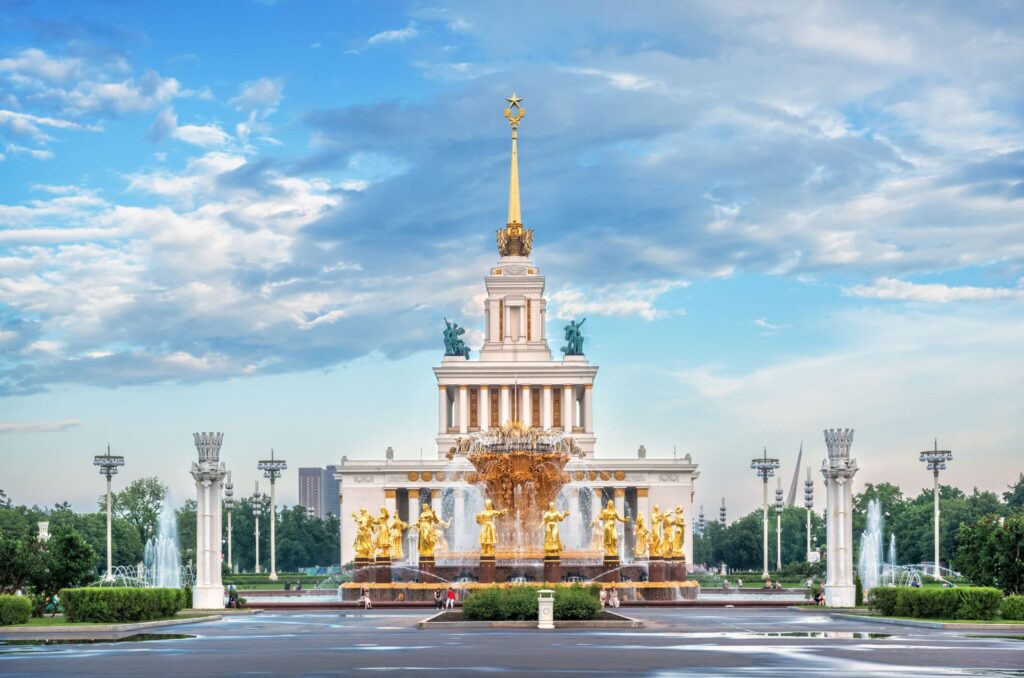
VDNKh — the Exhibition of Achievements of National Economy — occupies more than 300 hectares. A park, museum, exhibition complex, and architectural monument — all in one place.
Historic pavilions from the 1930s-1950s are decorated with mosaics, stucco, and sculpture. The famous «Friendship of Nations» fountain with gilded figures is one of the most recognizable monuments in the capital. The «Conquerors of Space» monument soars to 107 meters — it’s visible from afar.
On the territory of the complex, you’ll also find Moskvarium, an interactive model of Moscow, and numerous thematic exhibitions. VDNKh regularly hosts festivals and exhibitions — check the schedule before your visit.
The Museum of Cosmonautics at the base of the monument is one of the most popular museums in the capital. Real descent modules, Gagarin’s spacesuits, lunar soil samples, an exhibition on orbital stations. For science and space enthusiasts — a must-stop.
At VDNKh, plan for at least four hours. If you add the space museum — all six.
Non-Tourist Moscow: Bunker-42, Patriarch’s Ponds, and Bulgakov
The best impressions often hide beyond standard routes.
Bunker-42 on Taganka — a declassified underground command post at a depth of 65 meters, built at the height of the Cold War. This is the largest declassified facility of its kind in the world. Descending to the depth of an 18-story building via narrow staircases is an unforgettable experience. Tours are conducted in several languages.
Patriarch’s Ponds — a corner of Moscow with a special atmosphere. It was here that Bulgakov begins the action of the novel «The Master and Margarita»: Woland meets Berlioz on a bench by the pond. The Patriarch district is one of the most beautiful and expensive places in the capital: quiet lanes, restaurants, old mansions.
The Bulgakov Museum on Bolshaya Sadovaya — the «Bad Apartment» from the novel «The Master and Margarita.» Manuscripts, personal belongings, interactive installations. A literary pilgrimage in its purest form.
The Egg House on Chistye Prudy — a residential building in the shape of an egg among classical architecture. Small, strange, photogenic — worth a small detour.
For the Whole Family: Zoo, Planetarium, Circus, and Mosfilm
Moscow is perfectly suited for traveling with children. There are plenty of places here that are interesting for both children and adults.
Moscow Zoo — founded in 1864 and is one of the oldest in Europe. More than 10,000 animals, including giant pandas. The largest in Europe by number of species — a walk will take two to three hours.
Moscow Planetarium — a large star hall, the interactive museum «Lunarium,» an observatory. Located next to the zoo — convenient to combine.
Nikulin Circus on Tsvetnoy Boulevard — a famous old circus that has been operating for over a hundred years. The show requires no translation — pure emotions.
Mosfilm Film Studio — the largest in Russia. A tour of the sets, a collection of vintage cars, costumes from famous films. The studio’s exhibition captivates even without knowledge of Russian cinema.
Green Corners: The Apothecary Garden, Silver Forest, Hermitage Garden
When you want peace and quiet, Moscow offers intimate green spaces — many of them hidden from the mass tourist.
The Apothecary Garden — the oldest botanical garden in Russia, established by Peter I in 1706. A tropical greenhouse, a pond with carp, a collection of 18th-century conifers. A place for those who appreciate beauty and tranquility.
Silver Forest — a real pine forest within Moscow, surrounded by a bend in the river. Beaches, ecological trails, and the Zhivopisny Bridge — one of the most beautiful engineering structures in the city with an arch over 100 meters high.
Hermitage Garden — a historic park between Petrovka and Karetny Ryad, founded in 1894. Three theatres, linden walkways, summer terraces of restaurants. Open-air film screenings and concerts are held here — the atmosphere of old Moscow in its purest form.
Bauman Garden — a quiet old park in the Basmanny district. Less famous than Gorky Park, yet almost without crowds — an ideal place to rest between museum visits.
Contemporary Culture: Red October, Muzeon, and Gostiny Dvor
Moscow is not just classics. The city’s contemporary cultural life thrives in art clusters and creative spaces.
The Red October art cluster on an island between the Moscow River and the Vodootvodny Canal — a former chocolate factory that has become a center of attraction for galleries, studios, and restaurants. The view of the Kremlin and the Cathedral of Christ the Saviour from the embankment is one of the best in the city.
Muzeon Arts Park on Krymskaya Embankment — more than 700 sculptures in the open air, from Soviet monuments to contemporary installations. This is one of the most popular places for walks in the center — admission is free.
Gostiny Dvor — an 18th-century historic trading building between Red Square and Varvarka, designed by Quarenghi. Today, large exhibitions and fairs are held here.
Krutitsy Metochion — a medieval bishop’s residence lost among the residential quarters of the Tagansky district. Quiet, uncrowded, a feeling of traveling through time. A historic monument that rarely makes it into guidebooks.
The Central Children’s Store on Lubyanka — besides the store, there’s an observation terrace on the roof with a view of the city center. The ascent is free.
Practical Tips from G2R.Asia: How to Plan Your Route in Moscow
Two to three days is the optimal minimum for Moscow. Here’s how to distribute your time: first day — Red Square, the Kremlin, Nikolskaya, Arbat; second day — a museum, a park, and one of the panoramic points; third day — VDNKh, Patriarch’s Ponds, or an estate outside the center of the capital.
The Moscow Metro is not just transportation, but a full-fledged attraction. The Mayakovskaya, Komsomolskaya, and Novoslobodskaya stations are decorated with mosaics and marble. Riding a couple of stations just for the architecture is normal practice. Between points on your route, it’s convenient to alternate between the metro and taxis via apps.
Buy tickets to museums and towers online — this saves thirty minutes to an hour in queues. Many parks and observation decks are free. Tickets to the Bolshoi Theatre are a separate story; they need to be booked weeks in advance.
Moscow is one of the safest megacities in the world. The city center is well-lit, cameras are everywhere. Ordinary precautions are all you need.
The main advice — don’t try to see everything in one visit. Moscow is a city that people return to. And each time they find something new.The G2R.Asia platform will help you organize an exciting tour of Moscow tailored to your interests and schedule. To submit an application, simply complete a simple registration on the website and select the route that interests you.